

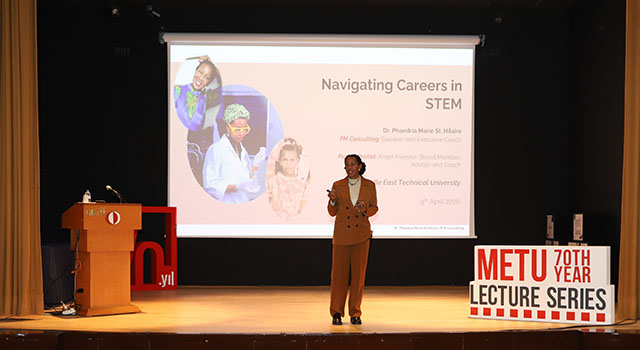
As part of the “Distinguished Lecture Series” organized for METU’s 70th anniversary celebrations, Dr. Phaedria Marie St. Hilaire, recognized for her leadership experience in the pharmaceutical and biotechnology sectors as well as her international work focused on diversity, equity, inclusion, and belonging, delivered a talk at METU Culture and Convention Center, Hall B, on April 9, 2026. In the event titled “Navigating Careers in STEM”, St. Hilaire drew on her own career journey to discuss career development in science, technology, engineering, and mathematics (STEM), the representation of women, mentorship, networking, and personal branding. The event was held as the second session of the program, which had begun earlier the same day with a talk by 2022 Nobel Laureate in Chemistry Prof. Dr. Morten Meldal.
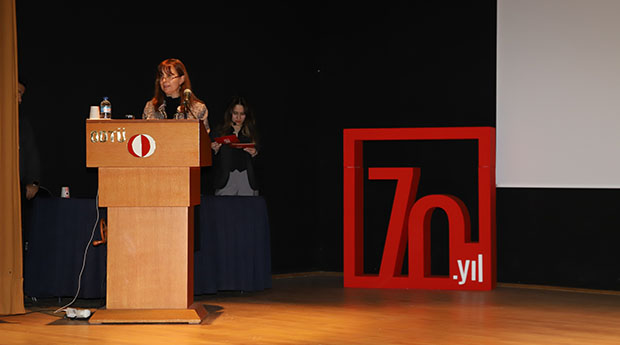
The opening remarks of the event, organized in cooperation with the Turkish Chemists’ Society and METU, were delivered by METU Vice President Prof. Dr. F. Pınar Acar. Taking the stage afterwards, Dr. St. Hilaire shared the story of how her relationship with science began in childhood and evolved into a career journey stretching from Dominica to international roles in science, investment, and advocacy. She noted that the curiosity and habit of observation she developed at an early age laid the foundation for her scientific interest, and emphasized that throughout her education and research career, mentorship and support networks were as decisive as personal effort in opening up opportunities.
Speaking about her professional transitions from academia to the biotechnology and pharmaceutical industries, Dr. St. Hilaire underlined that moving from researcher to leader required not only scientific expertise but also new skills in managing people, motivating teams, and inspiring others. Reflecting on turning points in her career, she said that she had initially considered pursuing medicine in line with socially dominant definitions of success, but later realized that research was more meaningful to her. She also explained that the experience of losing her job eventually led her toward leadership development, coaching, equality advocacy, and mentorship.
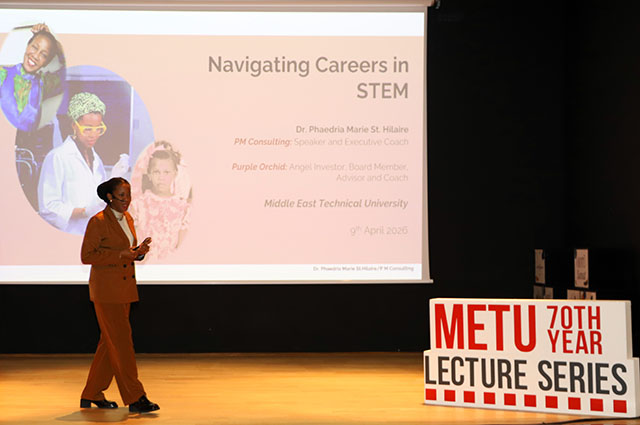
Dr. St. Hilaire also devoted particular attention to the representation of women in STEM, stating that women remain underrepresented in these fields and become less visible as seniority and decision-making power increase. She drew attention to the fact that the insufficient representation of women in future-shaping areas such as artificial intelligence, machine learning, and engineering may have important consequences both for equal opportunity and for the inclusiveness of the systems being developed. Stressing that this imbalance cannot be explained solely by individual choices, she said that factors such as gendered norms formed at an early age, bias in hiring and promotion processes, structural barriers, and the unequal distribution of care responsibilities must all be considered together.
Proposing multilayered solutions ranging from education to institutional policy, Dr. St. Hilaire emphasized the importance of encouraging girls to pursue STEM fields, increasing the visibility of role models, and expanding practices that support equality. Highlighting networking and personal branding as key elements of a successful career, she noted that building professional relationships and developing them intentionally play a major role in career advancement. She also addressed the distinction between mentors and sponsors, explaining that while mentors provide guidance, sponsors actively open doors to new opportunities. Personal branding, she added, is not simply a matter of being competent; it also requires clearly communicating what one offers, what one stands for, and what makes one distinctive.
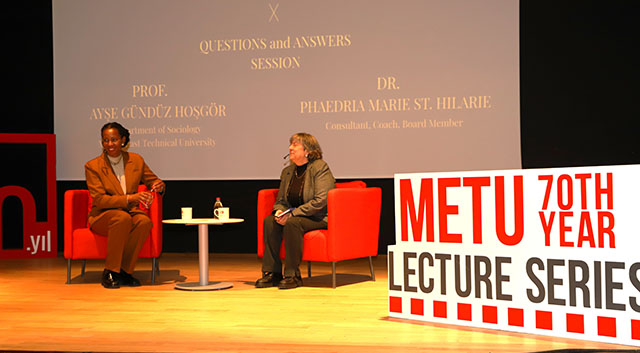
The talk was followed by a Q&A session moderated by Prof. Dr. Ayşe Gündüz Hoşgör of METU’s Department of Sociology. The event concluded with Prof. Dr. Pınar Acar presenting Dr. Phaedria Marie St. Hilaire with a certificate of appreciation and a gift on behalf of METU.