

“Chaos is merely order waiting to be deciphered.”
Jose Saramago
At first glance, disorder feels like the absence of meaning. We tend to associate order with symmetry, repetition, and clarity—and anything outside that, we call chaos. But science often teaches the opposite: what looks chaotic may simply be a form of order we do not yet understand.
This idea lies at the center of the research carried out by Prof. Kalay and the Kalay Research Group. Their work asks a deceptively simple question: Can we find structure in materials that appear completely disordered—even in liquids?
A material that breaks the rules
Most metals we encounter i.e., steel, copper, aluminum, are crystalline. Their atoms are arranged in neat, repeating patterns, like tiles on a floor. This regularity makes them easier to describe and predict.
Metallic glasses are different.
In these materials, atoms do not form repeating patterns. Instead, they resemble a frozen liquid, disordered, irregular, and complex. For a long time, scientists assumed this meant there was no meaningful structure beyond the immediate neighborhood of each atom.
But this assumption turns out to be incomplete.
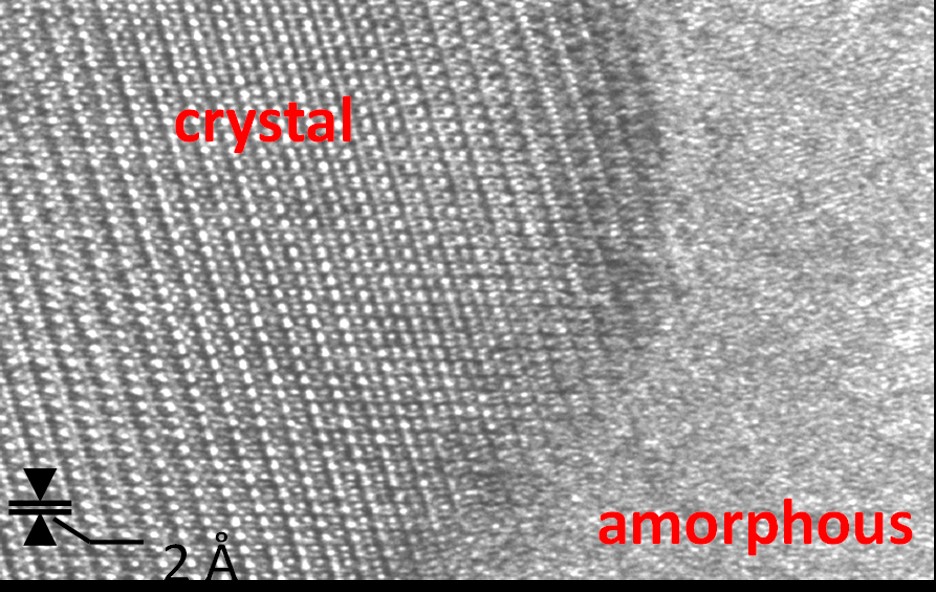
Research by Prof. Kalay shows that even in this apparent disorder, hidden patterns exist. Not perfect, repeating patterns like crystals, but subtle organizations, clusters of atoms that prefer certain arrangements and tend to group together over very small distances.
This is known as medium-range order. It is not obvious, not directly visible, but it plays a crucial role in determining the properties of the material.
Going one step further: Order in liquids
If metallic glasses are “frozen disorder,” an even more challenging question emerges: Can similar hidden structures exist in fully molten metals?
The Kalay Research Group extends its research into this regime using in-situ experiments, where materials are studied while they are in the liquid state. At high temperatures (i.e. above 1000 °C), atoms are constantly moving, bonds are continuously breaking and reforming, and any structure seems fleeting.
Yet, even in this dynamic environment, evidence suggests that short- and medium-range order persists.
Using synchrotron-based techniques at facilities such as Diamond (England), ALBA (Spain), Elettra (Italy), SOLEIL (France), and APS (USA), Kalay’s research group performs high-temperature scattering experiments that capture the behavior of atoms in real time. These experiments allow researchers to probe molten metals under realistic conditions, observing how local structures form, evolve, and disappear.
Once again, the data comes in the form of indirect signals, scattering patterns that must be carefully interpreted. By combining these measurements with molecular dynamics and Monte Carlo simulations, the group reconstructs the transient atomic arrangements present in the liquid.
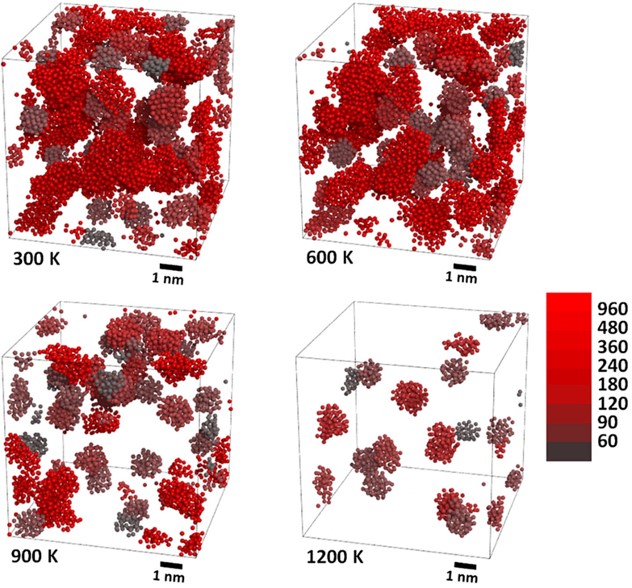
The emerging picture is striking: even in a fully molten state, metals are not completely random. They exhibit preferred local configurations and dynamic clusters that form and dissolve over time.
In other words, order exists even in motion.
Looking for patterns where none seem to exist
Whether in metallic glasses or molten metals, finding hidden structure is not straightforward. It requires tools that go beyond conventional microscopy.
Synchrotron radiation plays a central role in this effort, providing extremely intense X-ray beams capable of probing disordered systems with high precision. These experiments reveal fluctuations and correlations that are invisible to traditional techniques.
To interpret these signals, the Kalay Research Group integrates experimental data with computational methods such as molecular dynamics, Monte Carlo simulations, and density functional theory. This combined approach enables the reconstruction of realistic atomic-scale models.
Across both solid and liquid states, a consistent theme emerges: materials that appear disordered often contain rich and meaningful structural organization.
From shadows to maps: A new generation of microscopy
Recent work at the Rutherford Appleton Laboratory takes this exploration further using 4D-STEM.
This technique collects a diffraction pattern at every point in the material, generating detailed maps that link spatial position with structural information. It allows researchers to detect subtle variations in structure and even measure nanoscale strain fields.
What was once invisible becomes measurable.
A philosophical turn: What is order?
 This research naturally leads to a deeper question: What do we really mean by order?
For a long time, science equated order with symmetry and repetition. Crystals were the ideal, perfectly periodic and predictable. Everything else was seen as a deviation.
But metallic glasses challenge this view.
They suggest that order does not have to be static or repeating. It can be dynamic, statistical, and constantly evolving. In this sense, disorder is not the opposite of order; it is a different expression of it.
This idea resonates with broader themes across science and philosophy. Many systems in nature derive their organization not from rigid patterns, but from interactions and fluctuations.
A molten metal, constantly in motion, may still carry the fingerprints of structure. A metallic glass, frozen in place, may preserve the memory of that motion.
Seeing the unseen
In the end, this research is about more than a class of materials.
It is about perspective.
What if disorder is not something to avoid, but something to explore? What if complexity is not a limitation, but a source of insight?
By combining advanced experiments, computational modeling, and a willingness to question assumptions, the Kalay Research Group continues to reveal structures hidden within apparent chaos, whether in solid metallic glasses or in the flowing state of molten metals.
And perhaps the most important idea is this:
Sometimes, the most meaningful patterns are the ones that exist only for a moment, and yet leave a lasting trace.